01
Portfolio tracker
Normalize wallets, exchange and Robinhood-style brokerage records, cost notes, internal transfers, fees, rewards, and performance without claiming a live integration.
Explore portfolio tracking →AltcoinTrack.com is an independent research hub for clearer portfolio tracking across Bitcoin, Ethereum, Solana, DeFi, stablecoins, staked assets, real-world assets, tokenized stocks, DePIN, and Web3. Explore practical frameworks for wallets, market scanners, technical analysis, portfolio AI, and data APIs.
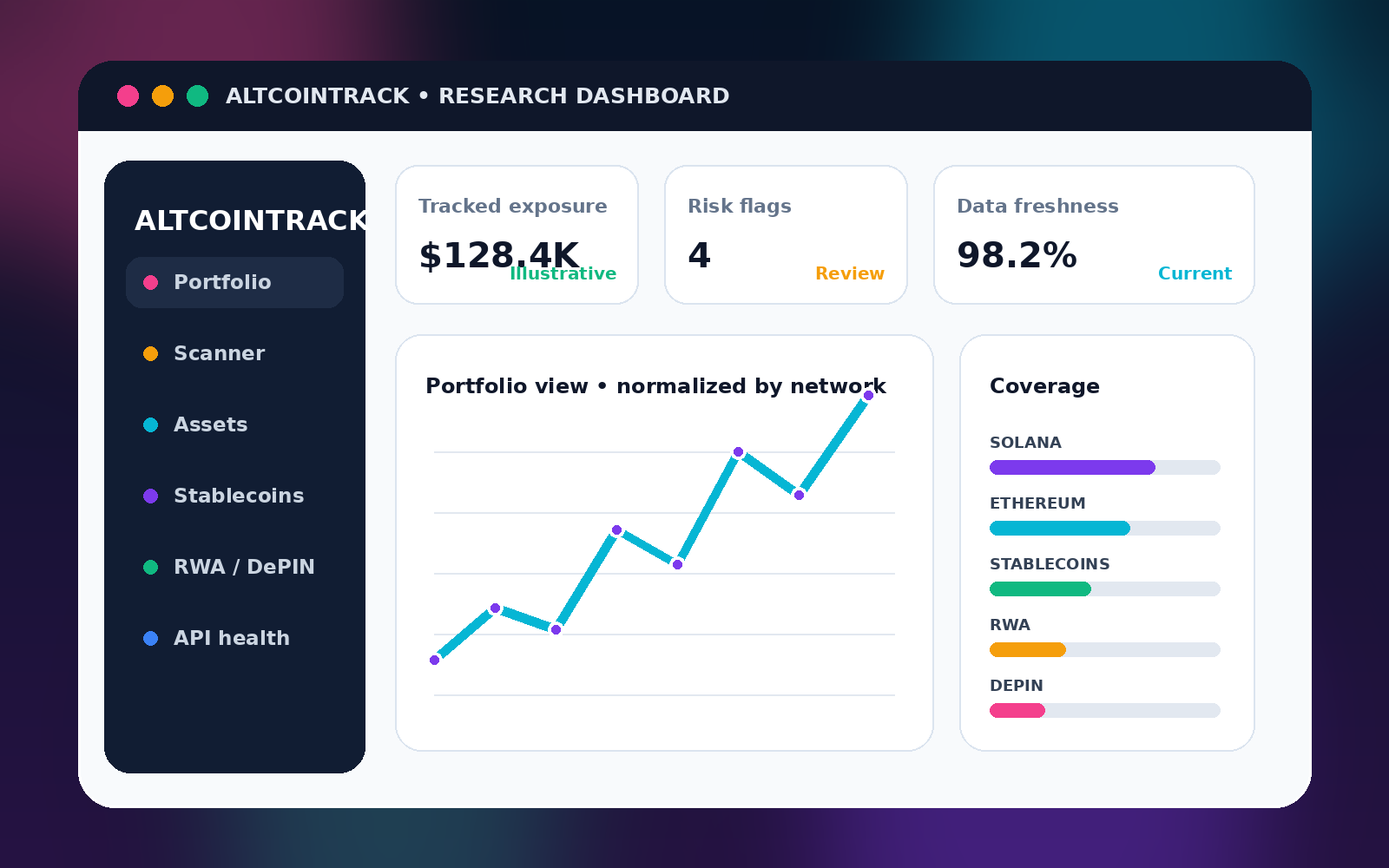
Four connected layers
A useful altcoin tracker is a system of records, not a single price screen. These layers keep ownership, market context, research, and implementation separate enough to audit.
Normalize wallets, exchange and Robinhood-style brokerage records, cost notes, internal transfers, fees, rewards, and performance without claiming a live integration.
Explore portfolio tracking →Design watchlists and scanners around canonical assets, liquidity, event time, reproducible technical-analysis indicators, and quality flags.
Explore scanner workflows →Separate token symbols from contracts, mints, issuers, bridges, validators, protocol receipts, legal claims, and physical networks.
Review asset coverage →Plan predictable endpoints and use AI for classification, anomaly review, scenario analysis, explanations, and constrained portfolio optimization.
Read the API blueprint →Broad coverage, precise identity
Bitcoin, Ethereum, Solana, DeFi receipts, stablecoins, staked assets, RWA tokens, tokenized stocks, DePIN rewards, and blockchain domain names do not share one data model. AltcoinTrack frameworks preserve those differences before aggregating value.
Repeatable workflow
AI optimization, TA tools, and HFT-style alerts become more useful after the asset and transaction record is coherent.
List owned accounts, watched addresses, excluded entities, reporting currency, and review period.
Key tokens by chain and contract or mint, then map friendly symbols and market pairs.
Classify trades, transfers, fees, rewards, staking, bridges, deposits, and withdrawals.
Add liquidity, concentration, counterparty, protocol, issuer, validator, and exit context.
AltcoinTrack Research Lab
Ten long-form guides translate the keyword landscape into distinct research and implementation tasks.
Design an altcoin scanner API with normalized identifiers, event time, liquidity filters, reproducible technical signals, rate limits, and security controls.
Read the guide →
Use AI and quantitative optimization for altcoin research while controlling data quality, unstable correlations, hidden constraints, and overconfidence.
Read the guide →
Monitor hardware-wallet holdings without exposing seed phrases or private keys while managing address discovery, privacy, labeling, and reconciliation.
Read the guide →Frequently asked questions
No. AltcoinTrack.com publishes educational research and product-design frameworks. It does not hold assets, execute trades, provide personalized investment advice, or claim live brokerage integrations.
Yes as a reconciliation method. Use statements, transaction records, or exports the provider makes available, then keep brokerage activity distinct from self-custody wallet data. AltcoinTrack.com does not claim an official Robinhood integration.
No. Portfolio monitoring should use public addresses, read-only data, or limited account records. Never provide seed phrases or private keys to a tracking service.
Separate stablecoins by issuer or protocol, network representation, redemption model, backing evidence, market liquidity, and bridge dependence rather than combining them into generic cash.
The token contract is only one layer. Legal issuer, holder rights, reference assets, custody, valuation schedule, transfer restrictions, settlement, and redemption also matter.
AI can organize data, classify activity, compare scenarios, and explain constraints. It should not be treated as an oracle. Inputs, objectives, liquidity, concentration limits, model version, and human review all matter.
Indicators summarize historical price, volume, and volatility under specific parameters. They are descriptive signals, not guarantees. Reproducible calculations and liquidity context are essential.
This static site provides a mobile product and workflow blueprint; it does not currently offer an app download. The mobile page explains what a secure read-only app should make visible.
Start with the portfolio blueprint, then deepen the model for Solana, Ethereum, stablecoins, tokenized assets, DePIN, staking, hardware wallets, AI, and scanner APIs.